Меню
0 800 334 615


Абразивний Комбінат
2026 is a year of systemic decisions and strategic transformation for Zaporizhzhia Abrasive Plant. The management formula “people – infrastructure – markets,” energy efficiency, technological modernization, and the strengthening of international presence are at the core of the company’s new strategy. We discuss the economics of resilience, market risks, and growth opportunities with Acting Chairman of the Management Board, Oleksandr Kozeratskyi.
The interview is released ahead of the company’s participation in INTERNATIONALE EISENWARENMESSE KÖLN, the world’s leading trade fair for tools and technological solutions that defines industry trends and development vectors.
STRATEGY & VISION 2026
– The company follows the management policy “people – infrastructure – markets.” What does this formula mean to you?
– People are the foundation. Competence, responsibility, initiative, and the ability to deliver results every day. The team determines the company’s capacity to adapt, withstand pressure, and move forward.
Infrastructure is the supporting framework. Raw material security, stable equipment operation, maintenance and service systems, energy efficiency, and safety. It is an economically sound production management model that ensures continuity even amid external risks.
Markets are the strategic horizon. Clear positioning, competitive products, long-term partnerships, and active protection of company interests at both international and national levels. Openness and transparency build trust — and trust drives stable sales and growth.
– Why did this triad become the basis of ZAK’s 2026 strategy?
– The war clearly showed that chaos leaves no room for resilience. Every initiative must deliver measurable results. Therefore, management decisions follow a clear logic: objective, implementation mechanism, and practical effect. The triad became our strategic framework because it structures every project and tests its viability.
We systematically apply the Plan–Do–Check–Act (PDCA) cycle: defining problems and goals with metrics, implementing solutions (including pilot scale), analysing results and deviations, and adjusting or standardizing effective practices.
Every decision has metrics; every process has accountability. Modern industry is no longer production inertia — it is economic management and efficient business processes. This approach enables adaptation, results, and development even under extreme conditions.
– Which direction is currently the most sensitive?
– Energy. Electrocorundum production is highly energy-intensive; electricity accounts for over one-third of cost structure. Energy pricing directly determines global competitiveness. Stability of supply, tariff predictability, and energy efficiency are not technical issues — they are conditions for survival.
– Is this model a response to wartime and global competition challenges?
– Absolutely. Today, structured management is not a choice of style but a prerequisite for resilience and growth.
– Key strategic priorities for 2026?
– Financial sustainability and profitability, increased production volumes, technological strengthening, consolidation of positions in export markets, and expansion of Ukrainian-made tools internationally. We see a real window of opportunity in the US and EU, where Ukrainian producers are beginning to replace traditional suppliers.
– Main risks for the Ukrainian abrasive industry in 2026?
– Loss of competitiveness due to energy costs. Without competitive electricity prices and predictable tariff policies, energy-intensive enterprises face production cuts or closure — risking industrial losses, export revenue decline, and job reduction.
MARKET & COMPETITION
– What is the primary threat from Chinese imports?
– Short-term affordability may look attractive, but long-term it destroys domestic manufacturing, erodes technological capacity, and causes job losses. Price-only competition undermines product quality and makes local producers unprofitable.
– What strategy should Ukrainian producers adopt?
– Markets seek reliability, stability, quality, and fair pricing — not simply the cheapest offer. Investment in technology, energy efficiency, and advanced management systems, including AI, is critical.
– Does sanctions policy influence competition?
– Yes. Sanctions remove products advantaged by subsidies or political distortions. But sanctions only create opportunity; retaining it requires competitive economics and stable production.
PRODUCT & PRODUCTION
– How did the war affect production processes?
– It shifted production from inertia to management discipline. Decisions are evaluated through energy, cost, and risk efficiency. Systemic control became a practical manifestation of resilience.
– How will ZAK strengthen competitiveness?
– By increasing efficiency and scalability: reducing energy intensity, modernizing technological regimes, expanding capacities, and focusing on higher value-added products.
– Product and quality priorities?
– Improving electrocorundum quality, stabilizing grade 15A (~95% Al₂O₃), developing calcination technologies, and implementing grain surface treatment technologies such as blue-firing and ceramic coating. In tools: advanced bond formulations, optimized porosity structures, reinforcement technologies, microstructure control, and geometric stability.
– Investment plans?
– Modernization of agglomerate preparation, furnace reconstruction, implementation of modular energy-efficient furnaces, AI-assisted smelting control systems, and upgrades to crushing operations. In tools production — modern pressing equipment and advanced bonding systems.
RETAIL & BRAND
– Why focus on retail growth now?
– Industrial consumption has declined due to wartime realities. Retail provides diversification, cash-flow stability, and direct customer feedback.
– How do you restore trust in the brand?
– Trust starts with product consistency, predictable performance, and systemic quality management.
– Priority sales channels?
– Export as the growth driver; retail as the stabilizing channel.
– New products in 2026?
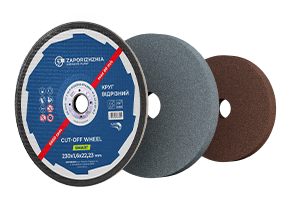
– Small-sized ceramic tools, grinding wheels made of alloyed abrasive materials, premium cutting wheels, porous-structure wheels, and specialized tools for high-alloy steels.
EXPORT & INTERNATIONAL DEVELOPMENT
– Plans for the US market?
– Consolidate achieved positions and expand presence in both materials and professional tools.
– Why is the US strategically important?
– It is the largest, most technologically advanced, and standards-defining market. Presence there confirms global competitiveness.
– EU expansion progress?
– Balanced competitive conditions allow systematic growth of abrasives supply and gradual entry into tools through partnerships.
– Impact of EU anti-dumping duties?
– They help level the playing field.
– Competing with global brands?
– Extremely challenging, but niche opportunities exist through flexibility and technology.
– Promising markets?
– US, EU, and emerging regions including the Middle East, Africa, and Latin America.
INTERNATIONALE EISENWARENMESSE KÖLN
– Strategic significance of participation?
– To reinforce positioning as a tools manufacturer and assess technological trends.
– Key objectives?
– Present innovations, hold negotiations with distributors and partners, and build a portfolio of prospective projects.
– Stand highlights?
– Ceramic-bond tools and small-sized ceramic solutions for professional and consumer segments.
– Expected market signals?
– Interest in alternatives to Chinese imports and demand for reliable European partners.
– Is the role of Ukrainian manufacturers changing?
– Yes. Ukraine is emerging as a stable and value-aligned supply source for European industry.
– ZAK’s role in Europe?
– A reliable partner and supplier of abrasive materials and tools.
ABOUT THE FUTURE
– How do you see ZAK by year-end?
– A profitable, steadily developing company strengthening its market positions.
– What defines success?
Profitability, predictable economics, significant production growth, and employer stability.
– What gives confidence despite the war?
– Team strength, technological base, and sustained international demand.
– Your key message to partners?
– Resilience for ZAK is not a slogan but a working principle. We are a reliable strategic partner committed to long-term cooperation and continuous development.